HK Rocsun is the Hong Kong marketing and export arm of a mainland China packaging group that designs and produces glass, plastic and metal containers, with glass jars and aluminum cans as its core lines. The manufacturing base sits in Hefei, China — established 2018, roughly 250 staff, a 45,000 m2 plant split into three specialised facilities for glass, plastic and metal respectively.
This profile is for buyers still in the research stage who need one answer before they request samples or issue a purchase order: does this glass jar supplier fit the product being filled, the destination market, and the order size? So instead of adjectives, it is organised around facts you can check against a supplier's documents and public records. Company-reported figures that are not independently verified are labelled as such; regulatory facts cite their source.
Why Glass Jar Sourcing Is a Documentation Exercise Now
Glass packaging keeps growing — Grand View Research projects the global market at USD 102.31 billion by 2030, spanning bottles, jars, ampoules and vials. But the rules around the jar have tightened.
In the EU, Regulation (EU) 2025/40 on packaging and packaging waste (PPWR) became the EU-wide framework for packaging placed on the market, including glass, adding design-for-recycling and material-specific recycling targets. Weight, material composition and recyclability are now specification inputs, not afterthoughts. Food-contact compliance runs on its own track: under Regulation (EC) No 1935/2004 food-contact materials must not transfer constituents that endanger health or alter the food; Commission Regulation (EC) No 2023/2006 obliges producers to run documented good manufacturing practice. The EU has not harmonised a glass-specific measure, so glass compliance rests on the framework, GMP and national provisions. In the US, organic coatings on glass containers and closures fall under 21 CFR 175.300; China applies GB 4806.5-2016.
Two consequences. You are assessing process discipline and documentation, not a single material certificate. And customs classification matters: glass jars fall under HS heading 7010, standard food-and-packing containers under HS 7010.90.
HK Rocsun at a Glance
| Attribute | Fact |
|---|---|
| Base | Hefei, Anhui, China (HK-registered marketing & export center) |
| Established | 2018 |
| Staff / area | ~250 staff; 45,000 m2 |
| Facilities | Three specialised units: glass, plastic, metal |
| Main products | Glass jars; aluminum cans |
| Industries served | Food, beverage, personal care, condiment, alcoholic beverage |
| Export ratio | 50% |
| Annual output | CNY 180,000,000 |
| Engineering team | 15 engineers |
| Certification | ISO 9001; FDA; CE |
Worth separating: the plant size, headcount and three-facility structure describe the physical operation. The CNY 180,000,000 output, the 15-engineer team, and the company-reported 10 million units/month on specific lines are self-reported and line-specific — confirm through an audit if order volume justifies it.
The glass jar-101 Platform
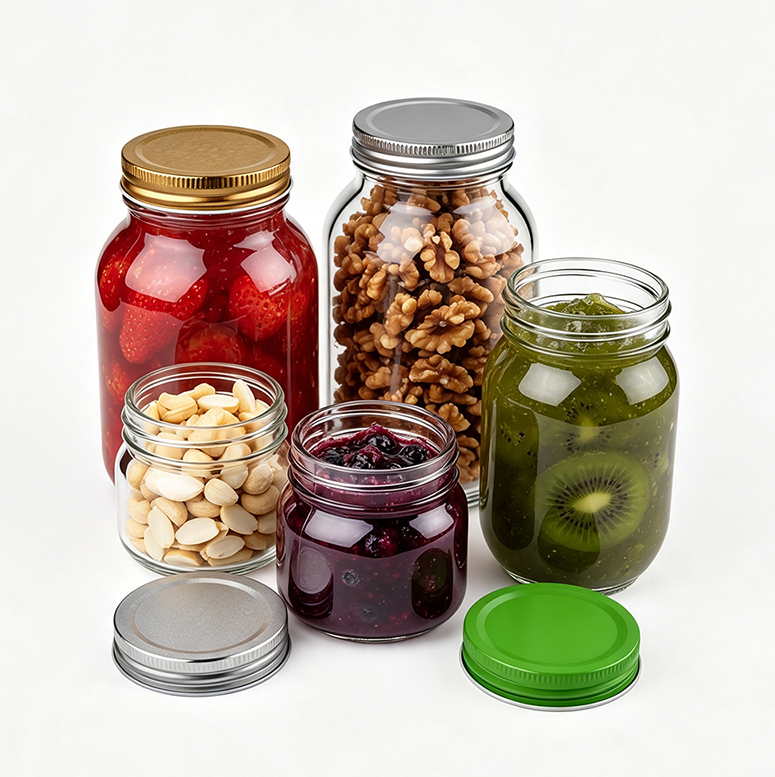
Jars ship under the glass jar-101 designation as a jar-and-lid unit with a matching lid assembly. It is a platform, not a single SKU: eleven families cover storage, Mason, freezing, honey, jam, coffee, pudding, spice, pickle, candle and cream jars.
- Shapes: hexagonal, round, square, cylindrical.
- Capacities: 200 ml, 250 ml, 500 ml, 750 ml, 1,000 ml, 1,500 ml.
- Glass: borosilicate or soda-lime; clear as standard, colour customisable.
- Seal: food-grade silicone or rubber.
- Decoration: screen printing, hot stamping (gold/silver), decals, custom logo.
- Lids: tinplate twist-off (rust-resistant, easy-open), aluminum, plastic, wooden, snap-on; lid materials wood, aluminum, plastic, tinplate screw cap.
- Closure choice is the single biggest driver of seal performance, shelf-life claims and downstream filling-line equipment. Because the jar ships jar-and-lid and lids come from a metal-capable unit in the group, seal and container are specified together — the coordination risk that bites many packaging projects is reduced.
Quality Control: Four Failure Modes
Control is built around the four ways glass jars actually fail in transit and on the shelf:
- Leakage — every unit passes a 100% airtightness test before shipment under seal-integrity control.
- Breakage in transit — packaging with dividers and foam cushioning, drop tests before shipment.
- Thermal shock — thermal stability validated by a thermal shock test.
- Heavy metals — raw materials and finished products tested to FDA and SGS standards for lead and cadmium, with randomised follow-up.
- ISO 9001, FDA and CE are a starting filter, not a conclusion. The EC 1935/2004 safety duty and the EC 2023/2006 GMP obligation are process requirements, so ask for current certificate copies with issuing body and scope, plus the finished-product test reports behind the claims.
Which Jar Fits Which Application
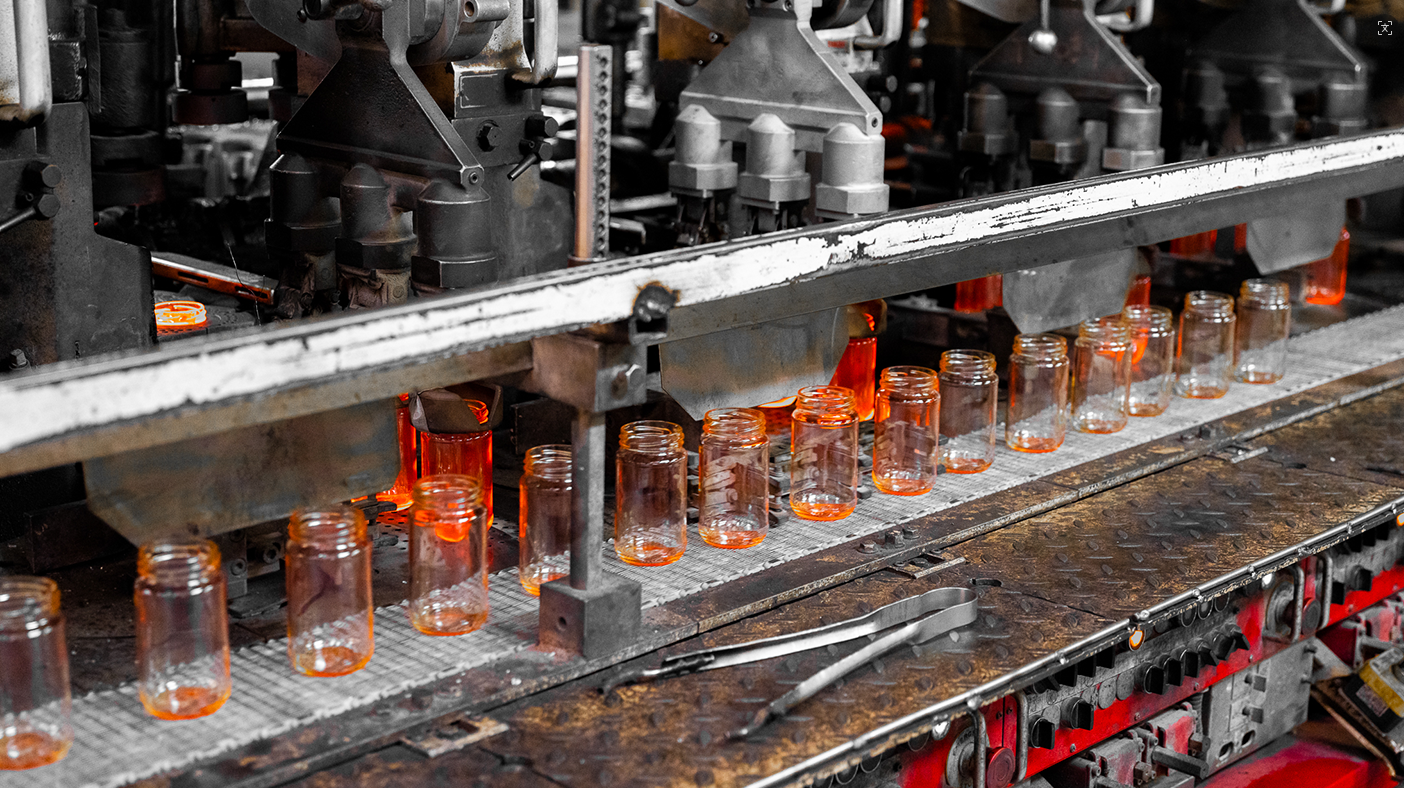
The range targets food, condiment, beauty and skincare, scented candle and home storage. Recorded working conditions: indoor, normal room temperature, dry environment, manual or semi-automatic filling and capping (filling, capping and labelling machines). Typical requirements: food-grade materials, FDA and LFGB compliance, leak-proof seal.
| Application | Jar family | Specification note |
|---|---|---|
| Honey | Honey jar | EU honey must meet Council Directive 2001/110/EC |
| Jam / jelly / marmalade | Jam jar | EU products under Council Directive 2001/113/EC |
| Pickles & preserves | Pickle jar | Seal integrity and headspace drive shelf life |
| Spices | Spice jar | Small formats from 200 ml; moisture/dust exclusion |
| Coffee | Coffee jar | Airtight closure to preserve aroma |
| Candy | Storage jar | Wide mouth supports filling and access |
| Skincare / balm | Cream jar | Non-food fill; confirm closure and liner compatibility |
| Scented candles | Candle jar | Request heat-resistance and thermal-shock data |
| Storage / freezing | Storage & freezing jar | Borosilicate vs soda-lime by temperature exposure |
Commercial Terms
| Term | Stated position |
|---|---|
| MOQ | 5,000 pcs for standard mass-production pricing |
| Incoterms | FOB, CIF and EXW all available |
| Payment | 30% T/T deposit before production, 70% T/T against a copy of the B/L |
| Inspection | Pre-shipment test with report; test items and AQL agreed before production |
| Customs | HS 7010; standard food/packing glass containers under HS 7010.90 |
How HK Rocsun Sits Against Other Suppliers
Glass jar buyers face a two-tier structure: large international container groups, and regional/specialised producers. HK Rocsun sits in the manufacturer-and-export tier with a stated one-stop scope across glass, plastic and metal. Reference points in the wider market (self-described roles from their own corporate sites, not a ranking): O-I Glass (US), Verallia (France), Ardagh Group (Luxembourg/Europe), Vidrala (Spain), Stoelzle (Austria), and ?i?ecam (Türkiye). Compare on capacity, certification and pricing obtained directly — this table asserts no market share or quality ranking.
Where HK Rocsun is a strong shortlist entry: building a multi-SKU range (a honey line, a jam line and a candle line together) consolidates specs with one supplier; jar-and-lid matched delivery ties seal to container; and a 5,000-pc MOQ with three Incoterms, agreed AQL and a documented pre-shipment report gives a predictable entry point, including trial volumes ahead of scale-up.
Weaker fit: buyers needing very large annual tonnage on internationally traded benchmarks, a clause-verified PPWR recyclability position with numeric targets, or candle jars with confirmed compliance against a specific fire-safety edition. Those need third-party verification beyond this profile.
From Research to a Verified Order
- Define fill and destination first — honey/jam in the EU bring product directives into scope; food-contact obligations follow the market (EC 1935/2004 + EC 2023/2006; 21 CFR 175.300 for coated US glass/closures; GB 4806.5-2016 in China).
- Write the jar spec — family, shape, capacity (200–1,500 ml), glass material, colour.
- Specify the closure — match the lid to your filling method and downstream capping machine.
- Request documents, not marketing files — current ISO 9001/FDA/CE copies with issuing body and scope, plus airtightness, thermal-shock and lead/cadmium test reports.
- Agree inspection and AQL before production, so the pre-shipment test is measured against a fixed standard.
- Confirm commercial terms — 5,000-pc MOQ, FOB/CIF/EXW, 30/70 T/T.
- Validate decoration and packaging — printing/hot-stamp/decals, dividers and foam, drop-test record.
- Ship and verify — pre-shipment test with report; customs under HS 7010.90.
FAQ
Are HK Rocsun glass jars compliant for food contact?
ISO 9001, FDA and CE are reported; raw materials and finished products are tested to FDA and SGS standards for lead and cadmium, every unit passes 100% airtightness, and thermal stability is validated by a thermal shock test. For the EU, glass compliance rests on the EC 1935/2004 framework plus the EC 2023/2006 GMP duty (no harmonised glass-specific measure), so request current certificate copies with scope and the finished-product test reports.
Can jars, lids and logos be customised?
Yes — custom logo, screen printing, gold/silver hot stamping and decals; customisation covers shape, capacity (200–1,500 ml), glass material, colour and lid material (wood, aluminum, plastic, tinplate screw cap). The jar ships jar-and-lid, so closure and decoration are specified together.
MOQ and Incoterms?
5,000 pcs for standard pricing. FOB, CIF and EXW available. Payment 30% T/T deposit before production, 70% against a copy of the B/L.
How are orders inspected before shipment?
A pre-shipment test with report, against test items and AQL agreed before production — covering the four failure modes (transit breakage, leakage, thermal shock, heavy-metal release).
Which markets, and how does a first inquiry work?
A reported 50% export ratio across food, condiment, beauty/skincare, candle and home storage; customs under HS 7010.90. A first inquiry is fastest when it states jar family, capacity, shape, lid type, decoration and destination market, so spec, sampling and quotation run in one step.
Next Step
Send your jar family, capacity, shape, closure and destination market to the HK Rocsun team for a specification review, sample arrangement and quotation. The right move at this stage is a spec sheet plus a document request — certificates with scope, test reports, confirmed AQL, and the closure matched to your filling and capping equipment — not a price request alone.
HK Rocsun International Packaging — Email: tom.ideabottle@gmail.com | Tel / WhatsApp: +86 185-5501-9935 | Website: www.ideabottles.com
| Kowloon, Hong Kong | Glass · Plastic · Metal food packaging; HK export center, integrated manufacturing in mainland China.