Most glass jar problems do not start in the warehouse. They start in a quotation email where the buyer writes "hexagonal jar, 500 ml" and the supplier answers with a photo, a price and a lead time. Six weeks later the lid leaks on a hot fill, or the cream oxidises because the gasket was not the grade that was quoted, and everyone goes back to the beginning.
A jar is a system of three parts: the body, the neck finish and the closure. Buyers who choose by silhouette and settle the closure afterwards usually pay for it twice — once in re-sampling, once in a delayed launch.
We build glass, plastic and metal packaging across three own factories, and jar orders come to us from skincare brands, candle makers, honey packers and jam producers. The questions that decide whether an order runs smoothly are almost never about shape. They are about what goes inside, at what temperature, and how it is closed.
Start with the fill, not the catalogue page
Write down four things before opening any catalogue:
- Fill weight and volume. 200 g of face cream, 250 g of honey and 8 oz of soy wax occupy the same nominal jar very differently. Headspace matters more than the printed capacity.
- Filling temperature. Cold fill, warm fill at 60–70 °C, or hot fill at 85 °C and above. This alone can eliminate a closure family.
- Product chemistry. Alcohol-based fragrance, acidic jam, oily balm and alkaline cream each interact with gaskets, liners and inner coatings differently.
- How the customer uses it. A jar that is opened daily with wet fingers has a different sealing requirement from a candle jar opened once.
A 500 ml honey jar and a 500 ml candle jar can share the same shape family and still need different closure behaviour: one has to survive a vacuum pull after hot filling, the other has to survive 50 hours of heat cycling without the wax contracting away from the glass.
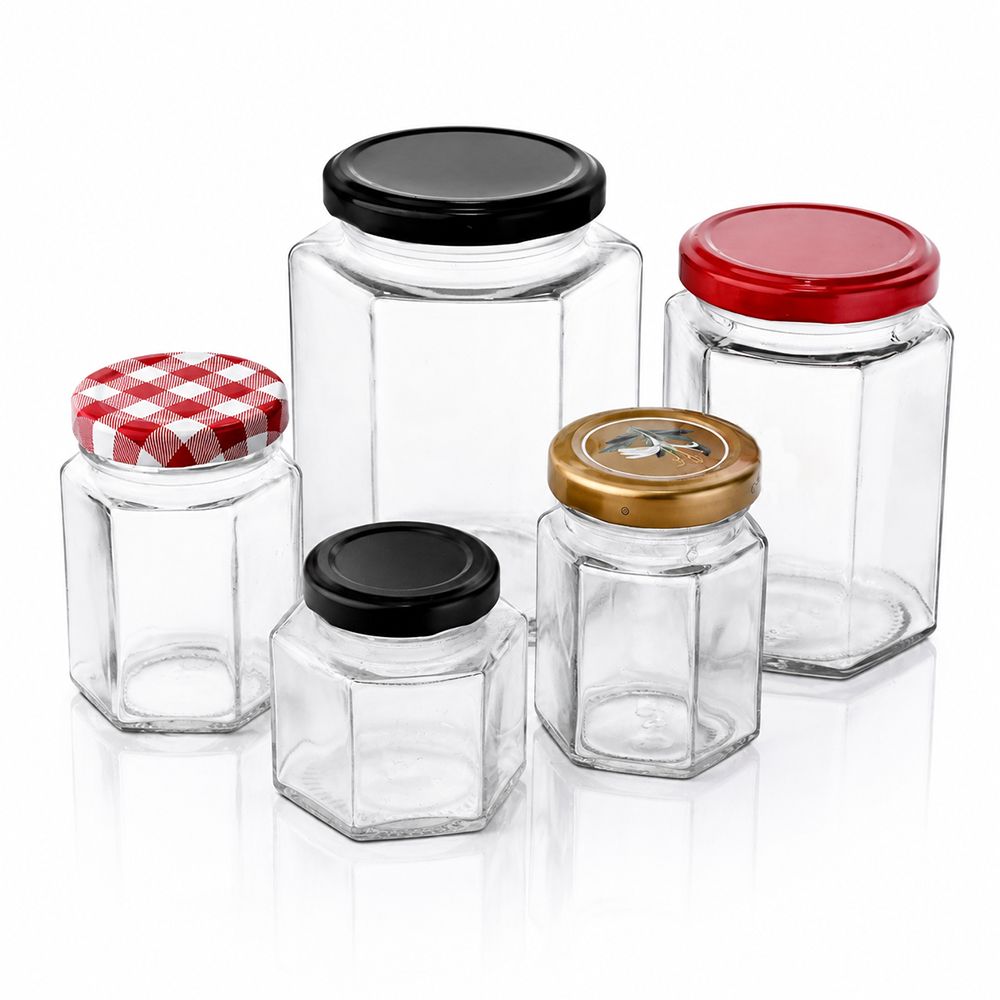
In our jar programme, jars ship as a jar-and-lid unit — tinplate twist-off, aluminium, plastic, wooden or snap-on lids — in hexagonal, round, square and cylindrical shapes from 200 ml to 1500 ml, in soda-lime or borosilicate glass. That range is wide on purpose. It is also why the specification has to be narrow before a sample is made.
Match the closure to the filling line, not to the look
Four closure families cover most jar work, and each has a natural job.
- Tinplate twist-off (43, 48, 53, 63, 70, 82 mm finishes). The workhorse for food jars. The plastisol liner seals against the glass land, the lid is steam-vacuumed after hot filling, and the safety button tells the consumer whether the vacuum held. Excellent for jam, honey, pickles and sauces. Less suitable for alcohol-based or highly oily cosmetic fills, where the liner chemistry has to be checked.
- Aluminium screw caps. Lighter and more premium in the hand, widely used for creams, balms and candle jars. Thread engagement and liner choice do the real work; a thin aluminium shell with a cheap liner will leak at the same rate as a bad plastic cap.
- Plastic caps and lids. Good cost position, good for wide-mouth candle and storage jars, available with EPE or PE foam liners. Watch heat resistance if the jar is filled warm or goes through a shrink tunnel.
- Snap-on lids. Common on candle and confectionery jars. Fast to close and pleasant to open, but they rely on dimensional consistency of the glass neck rather than on thread torque, so the glass tolerance has to be tight.
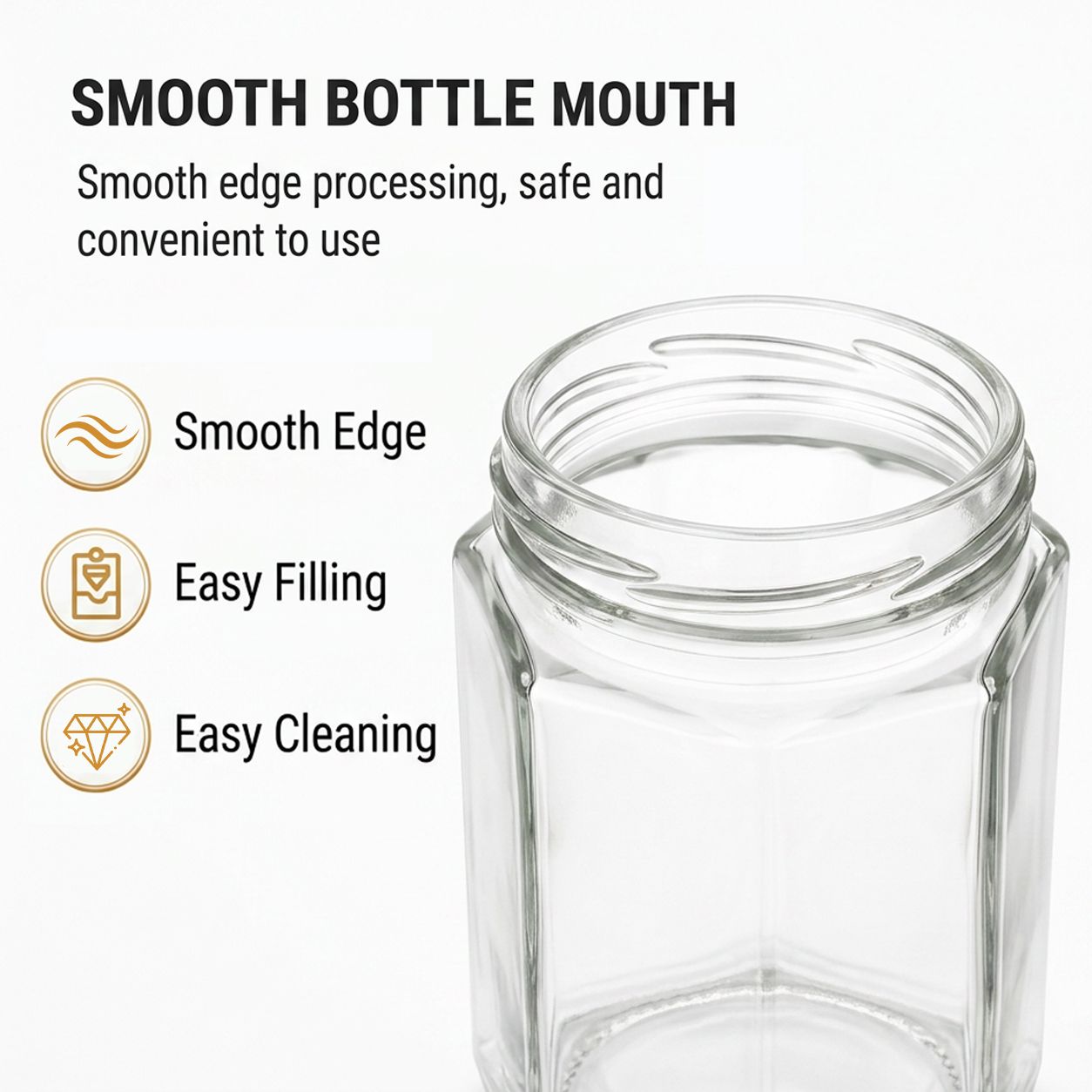
The point is not which closure is best. It is that the closure and the neck finish are one decision. A "63 mm jar" means nothing until you know whether the thread is 63 mm twist-off, 63 mm lug or 63 mm snap — three different moulds, three different capping heads.
Glass type decides more than clarity
Soda-lime glass covers the great majority of jars we ship: food jars, cream jars, candle jars, storage jars. It is the economical choice, it flints cleanly, and it takes frosting, colour spraying and decal well.
Borosilicate earns its higher price in specific cases: heat-shock resistance for jars that go from a hot fill to a cold shelf, or for products where thermal expansion of the container would stress the closure. It is not automatically "better glass". Putting borosilicate under a candle that never exceeds 70 °C usually buys nothing but cost.
Two quality points matter more than the type on the datasheet:
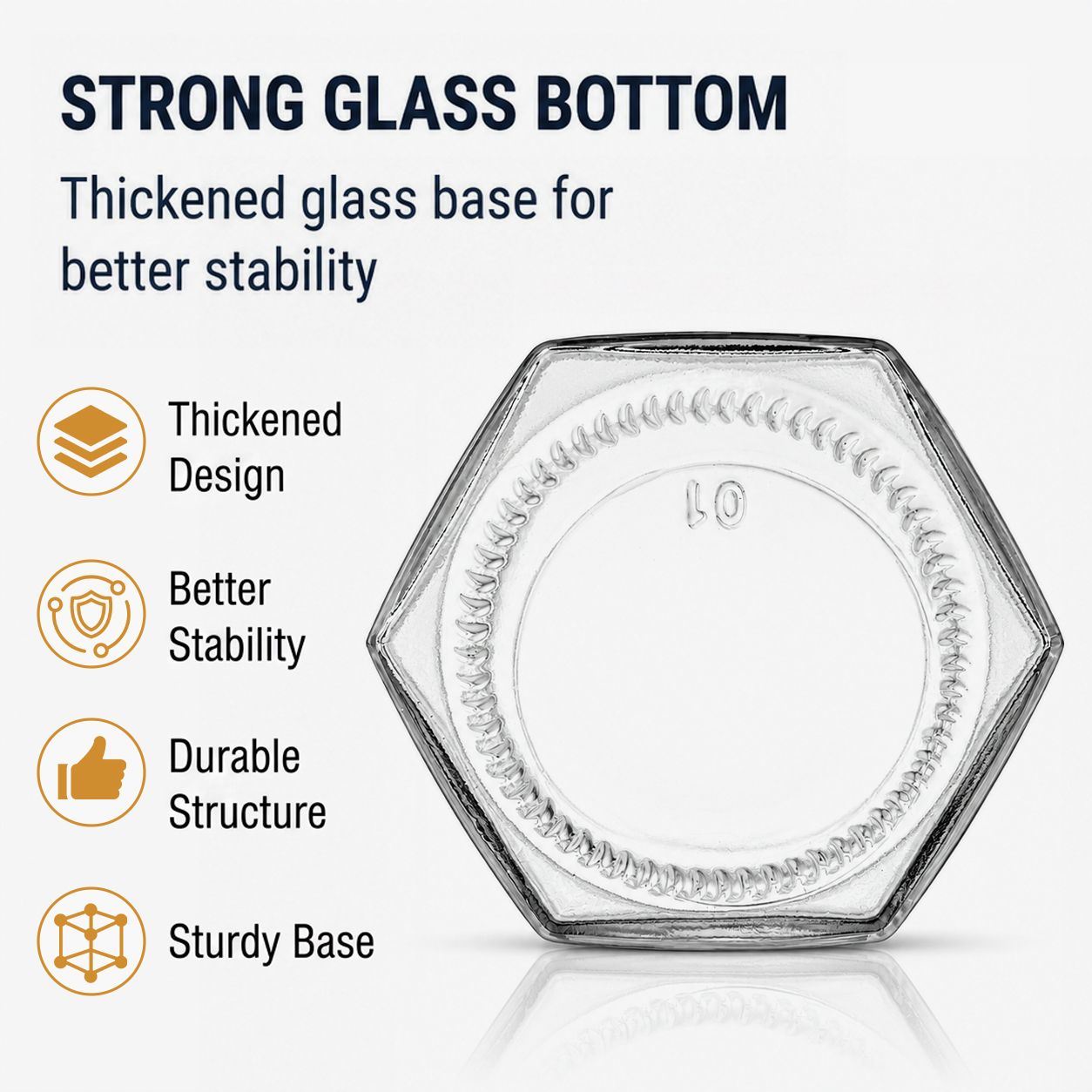
- Wall and bottom thickness distribution. A jar that is 3 mm at the shoulder and 1.6 mm at the base will fail in transit, not in the showroom.
- Annealing. Poorly annealed glass carries internal stress and cracks at the neck — exactly where the closure loads it.
Ask for the dimensional report and the annealing record, not only a photo of the mould.
 |  |
Documentation follows the same logic
Compliance is a qualification exercise, not a certificate collection.
In the EU, glass food-contact compliance rests on framework Regulation (EC) No 1935/2004 and mandatory good manufacturing practice under (EC) No 2023/2006. Because there is no single EU-wide glass composition measure, suppliers are qualified by evidence rather than by one certificate — a declaration of compliance, migration test data from an accredited lab, and a documented glass composition. In the US, glass is covered under FDA 21 CFR Parts 174–186, and the closure liner is a separate food-contact article that needs its own evidence.
For cosmetic jars the file looks different. The packaging itself is assessed under the product's safety report, and the practical questions are compatibility, closure integrity and preservative performance over the declared period after opening. A cream jar with a poor seal is a microbiological risk, not just a leaking box in transit.
Any supplier who cannot send a declaration of compliance, migration data and a liner specification before you pay a deposit is telling you something useful.
Lock the jar, then decorate
Frosting, colour spraying, gold gilding, silk screen and decal all sit downstream of the jar decision. They change the look, not the function — with two exceptions worth flagging early:
- Full-surface spraying can affect dimensional tolerances at the neck if the coating is thick. Specify the finish dimension after coating, not before.
- Decal firing puts the jar through a second heat cycle. Confirm the annealing and the dimensional stability with your supplier before artwork is approved.
The usual order of waste is: artwork approved, then glass changed, then artwork re-cut. Fix the container first and the decoration brief costs one round instead of three.
A workable sequence for a first order
This is roughly how we run a new jar project, and it holds whether the buyer is a 500-unit indie brand or a contract filler ordering by the container load.
- Fix fill weight, filling temperature and closure. One page, agreed in writing.
- Confirm glass type, neck finish and seal. Include the liner or gasket grade in the specification.
- Request the matching compliance file. Food-contact declaration and migration data, or cosmetic compatibility and seal performance data.
- Sample against the real fill. Fill the sample jar with the actual product at the actual temperature, not with water.
- Only then compare decoration, MOQ, tooling and price.
Steps 1 to 3 cost almost nothing and prevent most of the expensive surprises. Steps 4 and 5 are where projects usually start, and they are the reason sample rounds multiply.
What to send us
If you are sourcing jars for a cream, balm, candle, honey or preserve line, the fastest brief is five lines: fill weight, filling temperature, closure preference, annual volume and artwork stage. From that we can propose a jar-and-lid set, a glass type, and the documentation package that goes with it — before anyone talks about frosting.
Glass packaging rewards buyers who specify in the right order. Shape is the last decision, not the first.