Sourcing a custom glass coffee jar is not really a catalogue exercise. The real test is whether a supplier can take one written specification — capacity, neck finish, closure, glass colour, decoration, lid tooling and packaging — and reproduce it at stable quality across the whole order, with food-contact documentation that matches the destination market.
HK Rocsun works as the Hong Kong–based international sales and export arm for a packaging manufacturing group with glass jar production support in Anhui, China. The team provides OEM and ODM production for glass jar packaging, with a customization scope covering logo, packaging, graphic, color, surface handling, cap, size, mold and printing. The stated minimum order quantity is 5,000 pieces.
This guide is written for coffee brands, roasting companies, private-label buyers and importers who are moving from supplier evaluation into actual order execution. It focuses on the checks a buyer can verify on paper, on a sample and at pre-shipment inspection — not on brochure claims.
Why a coffee jar is a capability test
A coffee jar is three products in one: a glass container, a closure system and a brand surface. Each has its own failure mode. The container can chip or crack. The closure can leak or lose torque. The decoration can shift in colour between production runs. A jar that looks correct in a sample photo can still fail on a filling line or in transit.
Coffee adds another variable. The product reacts to light, oxygen, moisture and odour transfer. That means the specification has to be decided rather than assumed: glass colour or opacity, neck finish, liner and cap, fill weight and headspace, exterior print or surface treatment. These choices affect both product protection and branding.
For a buyer in the evaluation-to-execution stage, the useful question is not “Do you sell coffee jars?” It is whether the supplier can hold a written specification across 5,000, 50,000 or 500,000 pieces. Capability is what survives the jump from sample to shipment.
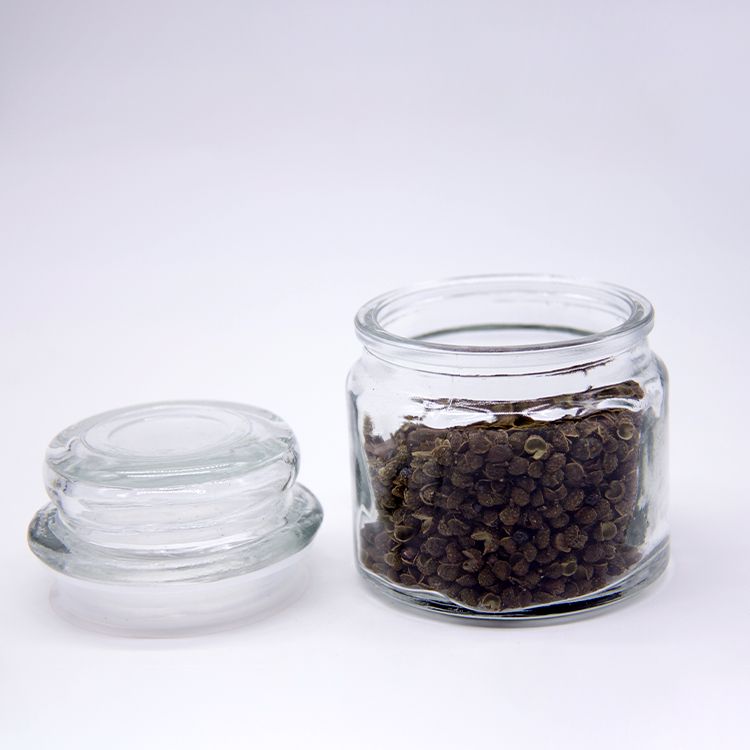
Put the specification on one page first
Before comparing quotations, fix the basic jar specification in writing. At minimum, this should cover:
- fill volume and target fill weight;
- jar format — round jar, mason-style jar, mini glass jar or large glass jar;
- neck finish and closure type;
- glass colour or opacity;
- wall thickness where relevant;
- exterior finish — spray, print, frosting or other surface handling;
- lid tooling requirements, if a custom closure is planned;
- retail packaging and carton configuration.
Without this one-page brief, suppliers end up quoting different products. One may price a plain jar with a standard lid; another may include printing, coating and a custom liner. The numbers look comparable but are not.
Compliance is a route, not a single certificate
Food-contact compliance for glass coffee jars is often misunderstood. In the EU, there is no harmonised glass-specific measure that replaces the framework. Regulation (EC) No 1935/2004 sets the general safety requirement: food-contact materials must not transfer constituents to food in quantities that could endanger health, cause an unacceptable change in composition or deteriorate organoleptic characteristics. Regulation (EC) No 2023/2006 requires documented good manufacturing practice for food-contact materials, including glass containers.
Because the EU has not harmonised a specific measure for glass, compliance usually rests on the framework requirement, GMP documentation and the national provisions of the destination member state. That is a paper trail rather than one certificate.
Other markets add their own layers. In the United States, resinous and polymeric coatings used as the food-contact surface — including organic coatings on glass containers and closures — fall under 21 CFR 175.300. China applies GB 4806.5-2016 to glass products in contact with food. On the trade side, glass jars and preserving jars are classified under HS heading 7010.
For a coffee jar buyer, the practical step is to list the documents required for the destination market before the supplier evaluation, not after the purchase order. Ask for a certificate of analysis covering the finished jar, not only the raw material.
What HK Rocsun can support for coffee jar OEM/ODM
HK Rocsun provides OEM and ODM production for glass jar packaging. The customization list is specific: logo, packaging, graphic, color, surface handling, cap, size, mold and printing. Custom mould development is supported as part of glass jar customization.
In practice, this covers the four areas a coffee jar project usually needs:
- Jar format — round jar, mason-style jar, mini glass jar or large glass jar.
- Closure — glass jar with lid, including cap and liner specification.
- Exterior finish — spray, print, frosting or other surface handling.
- Retail presentation — packaging, labels and graphic layout.
The commercial parameters are equally clear. Glass jar line capacity is stated at 500,000 pieces per month. The MOQ for standard mass-production pricing is 5,000 pieces. Lead time is banded by volume: 5,000–10,000 pieces in 7 days, 10,000–50,000 pieces in 20 days, and above 50,000 pieces negotiated per order. Incoterms offered are FOB, CIF and EXW. Payment terms are 30% T/T deposit before production and 70% T/T against a copy of the bill of lading. Quality control is pre-shipment inspection, and after-sales support is remote.
The group manufacturing base holds ISO 9001 certification, and its products have passed FDA and CE requirements. A certificate of analysis example, ZTS2510311ZZRC, was issued on 5 November 2025 by SHENZHEN ZTS TESTING SERVICE CO., LTD. for glass jar model IDG102, referencing EPA 3052, ASTM D3421, EN 14372, EN 14350 and EPA 3540C/3550C. That kind of document is a useful template for the COA a coffee jar buyer should request per order.
Capacity, MOQ and lead time: read them as planning inputs
A monthly capacity figure is a line capability number, not a reservation for one SKU. The same applies to MOQ and lead time. They are most useful when read against a launch plan.
If the first order is 8,000 pieces, the 7-day band applies. If it is 30,000 pieces, plan around 20 days. If it is above 50,000 pieces, delivery has to be scheduled per order rather than quoted from a standard table. Before signing, confirm which band the first order and the repeat order fall into, and check that the factory calendar supports both.
On delivery terms, EXW suits buyers with their own forwarder. FOB applies where the buyer nominates the vessel and pays freight. CIF applies where the supplier covers freight and insurance to the destination port. The 30/70 T/T structure ties the balance to a copy of the bill of lading rather than to a promise.
Four risks to close before the purchase order
Most coffee jar disputes come back to four risks. Each can be controlled in writing.
Leakage. Seal failure after filling, during storage or in consumer use usually comes from cap torque that is too low or too high, an aged or misaligned sealing ring, drops, pressure or temperature change, or long-term inverted storage. The stated control is 100% airtightness testing on every unit, combined with cap torque control that sets upper and lower limits and includes periodic equipment calibration.
Thermal shock. Cracks or shattering under sudden temperature change occur when the temperature differential exceeds material tolerance. The control is thermal stability design and validation, including a thermal shock test that defines the tolerable temperature differential, plus filling instructions that state the limits and warn against sudden hot-to-cold transitions.
Heavy metals. Lead, cadmium and other heavy metals can be released from glaze, ink, coating or metal parts in contact with food, particularly under acidic, hot or oily conditions, prolonged storage or surface abrasion. The stated control is end-to-end food-grade compliance: glaze, coating, ink and metal food-contact parts are sourced to food-grade requirements, and raw materials and finished products are tested by FDA and SGS for lead, cadmium and other heavy metals.
Breakage. Cracks, chips or breakage during transport or handling are controlled through anti-shock packaging with dividers and foam lining, individual compartments and pre-shipment drop testing that verifies the packaging holds up under handling and parcel sorting.
These controls are not marketing points. They are lines a buyer can put into the purchase order and check against the pre-shipment report.
From sample to shipment: a practical sequence
A coffee jar order usually runs through six checkpoints.
1. Lock the written specification. Capacity, neck finish, closure, colour, finish and decoration should all be fixed before sampling.
2. Confirm the compliance route. Match the destination market to the document list. EU, US and China each have different references, and coated closures may add another layer.
3. Select the customization dimensions. Use the nine listed options as a checklist. If a requirement is not on the list, treat it as a separate engineering question rather than an assumed capability.
4. Run the sample and first-article review. Compare the sample against the written specification, not against another sample. For custom mould development, this is where dimensional and visual tolerances are accepted or sent back.
5. Agree the acceptance standard before production. Fix the AQL and test items in writing. Pre-shipment inspection is only a check when the acceptance criteria are already agreed; otherwise it becomes a negotiation.
6. Verify packaging and transport safety. Dividers, foam lining, individual compartments and drop testing should be confirmed in writing. Breakage in transit is a cost that lands on the buyer even when the jar left the factory intact.
How the capability maps to real coffee orders
The strongest evidence that a supplier can run a coffee jar programme is a comparable order already in production. HK Rocsun’s manufacturing base reports three food-and-beverage packaging contracts that map onto the glass jar capability described here.
A coffee processing plant in Australia runs an annual contract value of USD 1.8 million for packaging material used in coffee production. A second coffee processing plant, operating globally, runs an annual contract value of USD 2 million. A food processing plant packing pickled products runs an annual contract value of USD 1.6 million. In all three, the reported result is stable production operation meeting food-grade packaging requirements, with food-grade compliance, sealing performance and corrosion resistance cited as the deciding attributes. Contract durations are not publicly disclosed.
The same production and inspection disciplines transfer to adjacent formats: honey jars, jam jars, candy jars, cookie jars and glass storage jars. A coffee brand that later extends into gifting or food-service packs does not necessarily need a new supplier.
FAQ
Is a glass coffee jar from HK Rocsun food-safe, and what evidence supports that?
Yes, subject to verification per order. The manufacturing base holds ISO 9001 certification, and its products have passed FDA and CE requirements. Heavy-metal control covers glaze, coating, ink and metal food-contact parts, with raw materials and finished products tested by FDA and SGS for lead, cadmium and other heavy metals. For the EU, the baseline remains Regulation (EC) No 1935/2004 and the GMP obligations of Regulation (EC) No 2023/2006. For China, GB 4806.5-2016 applies.
Can HK Rocsun supply OEM/ODM coffee jars with custom lid tooling?
Yes. The customization list includes cap, size, mold and printing, and custom mould development is supported as part of glass jar customization. A coffee brand can bring its own jar and lid drawings, or start from existing formats and adapt the closure, decoration and packaging. Confirm the lid tooling scope in writing, because cap and mould are separate customization dimensions.
What is the MOQ and how are payments structured?
The stated MOQ is 5,000 pieces for standard mass-production pricing. Payment terms are 30% T/T deposit before production and 70% T/T against a copy of the bill of lading. Delivery terms can be EXW, FOB or CIF, depending on whether the buyer has its own forwarder and wants to control freight.
How is sealing quality verified before shipment?
Every unit passes a 100% airtightness test before shipment, combined with cap torque control that sets upper and lower torque limits and includes periodic equipment calibration. Pre-shipment inspection is the stated quality-control method, with test items and AQL agreed before production starts and a test report provided before goods leave. Drop testing is also completed before shipment.
How fast can a 10,000-piece coffee jar order ship?
For 10,000–50,000 pieces, the quoted lead time is 20 days. For 5,000–10,000 pieces, it is 7 days. Above 50,000 pieces, delivery time is negotiable. The useful next step is to send the jar brief — capacity, closure, decoration, destination market and target quantity — and request a sample and quotation against it.
Next step
A custom coffee jar is a specification problem before it is a design problem. The supplier has to hold the jar, the closure, the decoration and the food-contact documentation together across the whole order. The buyer has to verify each of those on paper before the first pallet moves.
HK Rocsun supports OEM and ODM glass coffee jar projects from brief evaluation and sample confirmation through to export execution, with a Hong Kong commercial interface and glass jar production support in Anhui, China.
Send your jar family, target fill volume, closure preference, decoration requirements and order volume through www.rocsuneco.com and the team will respond with a configuration and quotation. Buyers evaluating custom mould or custom lid tooling should include the intended artwork and finish at first contact.