Most cookie jar projects start with a picture and end with a specification nobody wrote down. The jar gets chosen for how it looks on a countertop, then the buyer discovers halfway through sampling that the lid doesn’t seal the way the filling line needs, or that the decoration method they assumed isn’t available at the volume they’re ordering, or that the compliance document on file covers a different model number entirely.
HK Rocsun handles the international sales and export side for a manufacturing group with its own glass factory in Anhui. The glass lines run food-grade bottles and jars under process control, with impact resistance built in through glass formulation, wall thickness discipline and moulding precision. Standard formats are available, and custom shape, capacity, colour and surface decoration are supported. This piece is about the decisions that sit between “we want a cookie jar” and a purchase order that actually ships.
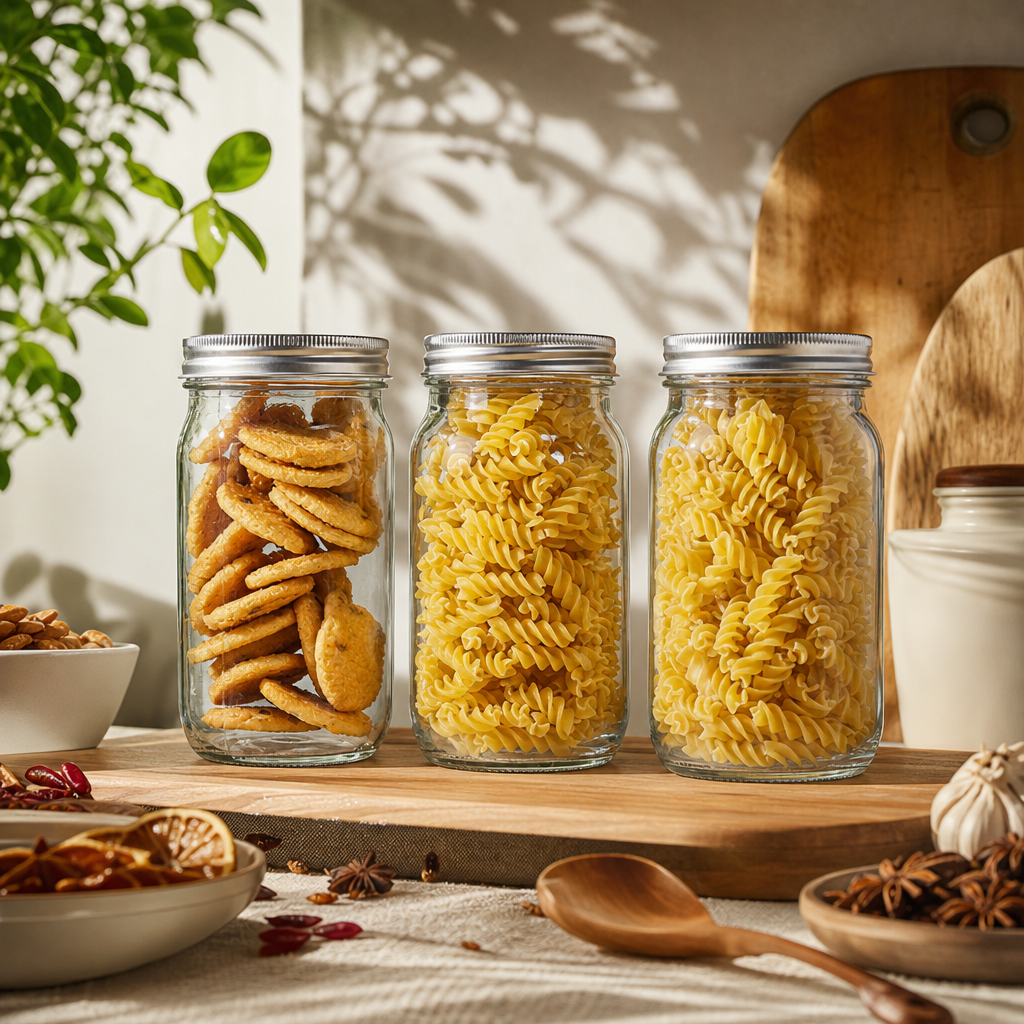
A cookie jar is a container with a job
Strip away the styling and a cookie jar is a wide-mouth glass storage vessel for dry baked goods and ambient-stable products. Wide mouth matters for filling and for getting a hand in. An interior without tight corners matters for cleaning. Those are functional facts, not design opinions.
The same glass family carries candy, coffee beans, spices, honey, jam or candle wax without changing the procurement logic much: define what goes in, define how it closes, define the food-contact or application requirement, then confirm the supplier can document it and repeat it.
Five things should be fixed early — usable capacity, mouth and shoulder geometry, lid and seal system, decoration method, and order quantity. Any one left vague turns quotations into guesswork.
Build the constraint sheet before you email anyone
Separate what the jar cannot ship without from what you would prefer. A fixed requirement might be food-grade contact material or a specific closure type. A preference might be a tint or a lid finish.
Capacity. The HK Rocsun glass storage range runs from a 45 ml sample jar up to a 730 ml bulk container in the hexagonal format, with eight standard sizes in between. But a 180 ml jar and a 730 ml jar are different retail formats and different filling operations. Work out the volume you need from product fill, headspace and any insert before picking a stock size.
Shape. Round, square, cylindrical or hexagonal. This affects shelf presence, how efficiently jars pack into a carton, label area, and how much protective packaging you need.
Glass material. Borosilicate or soda-lime. Match the material to the filling, handling and thermal conditions of the application, not to a generic “premium” label.
Colour. Clear as standard, other colours customisable. Colour changes product visibility and usually triggers a separate colour and decoration approval step.
Lid and seal. Metal screw cap, aluminium, plastic or wood, with a food-grade silicone or rubber gasket. The closure is the main control point for moisture and dust, and for leakage in transit. The hexagonal jar uses a thickened metal lid with a built-in food-grade sealing pad that seats against a precision-ground jar mouth. That combination is what makes a decorative lid into a moisture barrier.
Decoration. Screen printing, hot stamping, decals or labels. Each changes the approval sequence and the minimum order planning.
Compliance is a document trail, not a product photo
Buyers should request a model specific Certificate of Analysis (COA). A COA is not a blanket certificate for every jar in a catalogue. When reviewing a COA for “GLASS JAR, model IDG102”, confirm your quoted jar’s capacity, decoration and full lid assembly fall within its documented scope. If not, obtain documentation matching your exact specification.
Regulatory requirements differ by export market.
- EU: Under Regulation (EC) No 1935/2004, food contact jars and closures cannot release harmful substances or compromise food quality. Regulation (EC) No-2023/2006 mandates documented GMP. There is no harmonised EU wide glass standard; compliance depends on framework rules, GMP records and individual member state provisions — proven by full paperwork, not a single certification stamp.
- US: Coated or decorated glass with food contact resin/polymer coatings must follow 21 CFR-175.300.
- China: Food contact glass complies with GB-4806.5-2016.
For customs classification, preserving jars use HS 7010; general food?packing glass containers fall under HS-7010.90. Always verify country?specific import duties.
The EU PPWR (Regulation (EU) 2025/40) enters general force on 12-August-2026. All glass containers placed on the EU market from this date require a recyclability rating, declaration of conformity and volume weight minimisation justification.
For food jar projects, wall thickness and jar weight are now compliance factors, not only cost factors. Closures, gaskets and decoration must be assessed as one complete packaging unit, not separate parts. Manufacturers meet these requirements via precise moulding and controlled wall thickness to maintain impact resistance.
What the HK Rocsun glass jar range covers
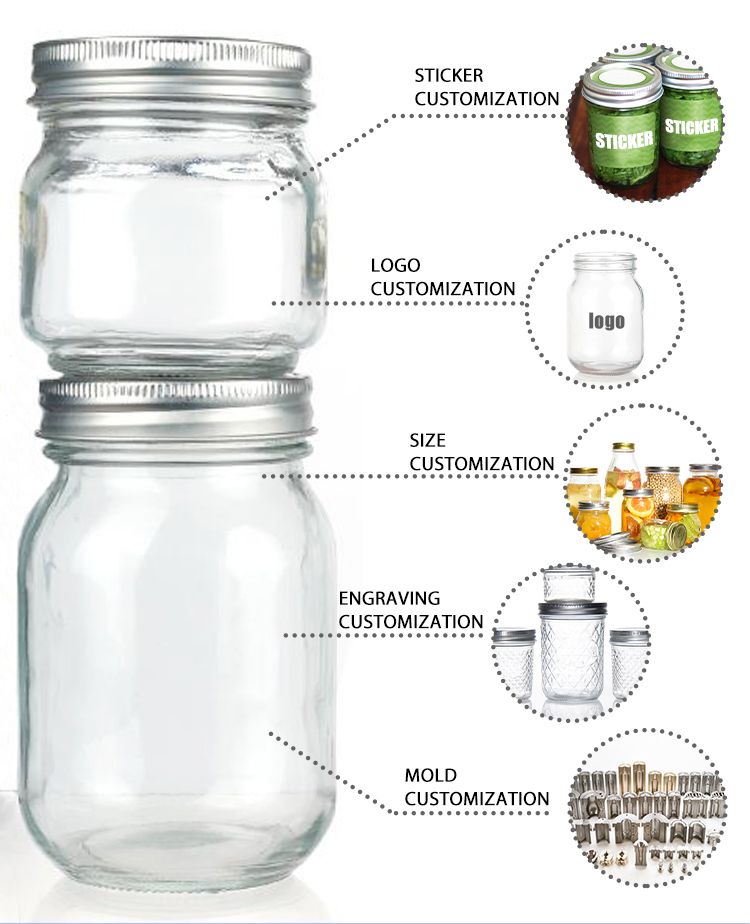
The cookie jar is bought through OEM or ODM. Customisation covers logo, packaging, graphic, colour, surface handling, cap, size, mold and printing. A cookie jar brief usually lands on four of those: the jar format, the lid and seal, the exterior decoration, and the retail packaging.
The hexagonal storage jar is a useful reference because it shows the level of specification published on the site: eight capacities, a size table with neck diameter, height, body diameter and single-jar weight, lid options in silver galvanised, black coated and red metal, and a jar mouth ground to seat the sealing pad. The bottom carries an anti-slip textured pattern, which matters less for shelf appeal and more for stable stacking in a warehouse or on a retail display.
Commercial parameters are stated rather than implied: MOQ 5,000 pieces, glass jar line capacity 500,000 pieces per month, lead time 7 days for 5,000–10,000 pieces and 20 days for 10,000–50,000 pieces, with above 50,000 negotiated per order. Incoterms cover FOB, CIF and EXW; payment is 30% T/T deposit before production and 70% T/T against a copy of the bill of lading. Quality control is pre-shipment inspection, and after-sales support is remote.
The closure is where cookie jar programmes quietly fail
A cookie jar lid has two jobs: keep moisture out and stay shut in transit. A decorative lid that seals inconsistently is a different product from a closure system specified for moisture control.
On the hexagonal jar, the seal path is a thickened metal lid compressing a food-grade gasket against a ground jar mouth. That is a specification, not a marketing phrase. The buyer’s job is to confirm the gasket material against the filling line and the expected reuse pattern, and to check that the torque window suits the capping method. A wide-mouth screw jar may suit manual or semi-automatic capping; a friction-fit lid may suit a different retail and reuse habit. Neither is universally better.
Two closure checks belong in the purchase order. First, airtightness or leak testing on every unit with a pass criterion. Second, torque limits with upper and lower bounds and periodic equipment calibration. Without a torque window, “tight enough” becomes a subjective judgment on the filling line.
Decoration: approve it on a physical sample, not a PDF
Screen printing, hot stamping and decals are all available. Clear glass is standard; other colours are customisable. Decoration changes the approval sequence. A screen-printed jar needs artwork approval, a colour standard and a defined print area. A hot-stamped jar needs a foil colour and a decoration position. A labelled jar needs label material, adhesive and surface compatibility.
For a cookie jar that will be reused, ask the durability question early. Hot stamping gives a metallic accent and survives normal handling, but heavy abrasion and solvent exposure are a different test. Screen printing with the right ink and curing can be formulated for abrasion, moisture and wear resistance. The source data confirms the methods; it does not publish dishwasher or abrasion results for every SKU. If the jar is going into a channel where repeated washing is expected, request those results at sampling and approve the decoration on a physical piece rather than on a screen proof.
Keep the glass specification separate from the decoration specification. That way an artwork revision does not accidentally reopen the jar or closure decision.
Order economics: MOQ is a starting line, not a unit price
MOQ 5,000 pieces anchors the low-volume end of standard mass-production pricing. It does not define a unit price, and no public price band is stated for the cookie jar — that is normal for a custom glass programme. Price moves with capacity, glass type, lid material, gasket, decoration, packaging and quantity.
Two commercial boundaries are worth flagging. A 5,000-piece MOQ can be too high for a small seasonal trial or a short gift range. And the 7-day and 20-day lead-time bands assume a standard specification with a confirmed decoration route; a new lid colour, a custom mould or a complex print can move the schedule even when the capacity is unchanged.
The practical move is to ask for a production schedule that separates sampling, artwork approval, bulk production and pre-shipment inspection. That schedule is more useful than a single lead-time number, because it shows where the calendar can slip.
A buyer-side checklist
Stage 1 — Product definition. Capacity, shape and fill volume. Request a dimension drawing with millilitre capacity and a fill/headspace calculation.
Stage 2 — Closure and seal. Lid material, gasket type, capping method. Request a lid specification and closure drawing, and confirm the leak-proof claim in writing.
Stage 3 — Compliance. Destination-market rules and model coverage. Request a COA or test report with model number, standard and date; for the EU, add the PPWR declaration and recyclability grade.
Stage 4 — Decoration. Print method, colour standard, decoration position. Approve on a physical sample and confirm the durability expectation for the intended reuse pattern.
Stage 5 — Commercial terms. MOQ, Incoterm, payment structure and a production schedule split into sampling, bulk and inspection.
Stage 6 — Transport. Divider and cushioning specification, drop-test evidence where available. Glass is heavier than plastic or metal and breakage lands on the buyer even when the jar left the factory intact.
FAQ
What capacities and shapes are available for a cookie jar?
The HK Rocsun glass storage range includes a hexagonal format from 45 ml to 730 ml across eight standard capacities, with a published size table covering neck diameter, height, body diameter and single-jar weight. Round, square and cylindrical formats are also within the glass jar programme. The right capacity is driven by fill volume, headspace and retail format, not by the name “cookie jar.”
What lid and seal options exist?
Metal screw caps in silver galvanised, black coated and red are available for the hexagonal jar, with a thickened lid wall and a built-in food-grade sealing pad that seats against a precision-ground mouth. Aluminium, plastic and wood lids are within the wider programme. The gasket is food-grade silicone or rubber. Confirm the gasket and torque window against the actual filling and capping method.
What food-contact documents can I request?
A Certificate of Analysis covering the specific glass jar model, with the test methods and date stated. Confirm that the quoted model, capacity and decoration fall inside the document scope. For EU destinations, the framework requirements under Regulation (EC) No 1935/2004 and the GMP obligations under Regulation (EC) No 2023/2006 apply, together with the PPWR declaration and recyclability grade from 12 August 2026.
What is the MOQ and lead time?
MOQ is 5,000 pieces. Lead time is 7 days for 5,000–10,000 pieces and 20 days for 10,000–50,000 pieces; above 50,000 pieces, delivery is negotiated per order. Payment is 30% T/T deposit before production and 70% T/T against a copy of the bill of lading.
Can a cookie jar be decorated with a custom logo?
Yes. Customisation covers logo printing, surface engraving, sticker branding and custom mould development. Printing options include screen printing, hot stamping and decals. Approve decoration on a physical sample, and if the jar will be washed repeatedly, ask for abrasion or wash-durability evidence at that stage.
How is quality checked before shipment?
Pre-shipment inspection is the stated control. The buyer should fix the AQL and test items before production, so the inspection report works as an acceptance document rather than a negotiation. Seal integrity, closure torque and packaging drop performance are the three items worth writing into the plan for a cookie jar programme.
Ready to build a cookie jar brief?
Send the fill volume, jar format, lid preference, decoration route and target quantity through www.rocsuneco.com. The HK Rocsun team coordinates with the Anhui glass factory on sampling, specification and export execution, so the first response can be a configuration against your brief rather than a catalogue page.