An aluminum can sourcing program rarely fails at the negotiation table. It fails at one of four technical checkpoints: the food-contact compliance documentation does not match the destination market, the can body and lid do not fit the filling line, the order falls below the supplier's minimum quantity, or the delivery slot clashes with the production calendar.
All four are verifiable before a purchase order is issued, and none of them can be repaired by a price concession afterwards.
This guide evaluates an aluminum can supply program against four documented constraints: food-contact compliance (BPA-free internal coating backed by third-party lab reports and batch-level Certificates of Analysis), dimensional specification (can format, capacity, 202# or 206# end sizing, SOT / EOE / full-open lid), commercial envelope (MOQ of 100,000 pcs, FOB / CIF / EXW terms, 30% T/T deposit and 70% T/T against B/L copy), and lead time scalability.
Corporate Profile: HK Rocsun at a Glance
HK Rocsun (Rocsun Eco) is a premier one-stop container packaging solution provider, supplying custom metal cans, glass jars, bottles, and eco-friendly packaging to beverage, craft beer, food, personal care, and alcohol brands worldwide. Operating through our international business headquarters in Hong Kong alongside extensive specialized production bases, we combine large-scale manufacturing capability with global trade efficiency.
| Company Fact | Published Technical & Commercial Detail |
|---|---|
| Brand & Trading Entity | HK Rocsun / Rocsun Eco |
| Production Footprint | 45,000 m2 across 3 specialized facilities (Glass, Plastic, Metal Packaging) |
| Industry Experience | Over 20 years in container manufacturing and international export |
| Workforce | 250 staff, supported by an in-house R&D team of 15 senior engineers |
| Monthly Metal Output | 300,000,000 pcs / month |
| Annual Group Output | 180,000,000 CNY |
| Global Export Ratio | 50% export ratio, supplying 2,500+ clients across 150+ countries and regions |
| Facility Certifications | ISO 9001, FDA, CE compliant |
| Official Contact | tom.ideabottle@gmail.com | +86 185-5501-9935 | rocsuneco.com |
Having HK Rocsun lead all international sales, contracting, shipping documentation, and multi-currency billing gives global buyers a commercially familiar, low-risk point of contact while directly backed by high-capacity primary manufacturing infrastructure.
Why "Metal Can" Is a Category, Not a Specification
In everyday trade language, the generic label "tin can" is often applied loosely to all metal food and beverage containers. Search phrases such as aluminum tin can or tin can packaging routinely lead buyers to aluminum-bodied beverage containers.
For procurement managers, the distinction that matters is the body material: aluminum alloy and tinplate behave completely differently in forming, structural weight, corrosion resistance, and high-speed line seaming. Everything in this guide refers to two-piece aluminum cans built from food-grade aluminum alloy with a seamed easy-open end.
The practical difficulty is that a simple quotation sheet answers none of the questions that decide whether a container actually works. Four critical gaps sit between a price quote and a production-ready can:
- Gap 1 — Body & Material Terminology: A request written as "beverage can, 330 ml, standard" leaves the alloy grade, internal lining thickness, and end format completely undefined. Two suppliers can quote the exact same line item and deliver cans that behave entirely differently on the same filling line.
- Gap 2 — The End & The Seaming Line: The can lid is a separate technical specification from the can body. End diameter (202# or 206#) and opening style (SOT, EOE, or full-open) dictate whether your seamer can run the container at designed line speed. A can that seals manually in a lab trial can still jam an automatic high-speed line.
- Gap 3 — Internal Coating & Compliance Evidence: For any beverage or food application, the internal lining is the direct food-contact surface. Buyers need a strict specification (BPA-free) and the physical proof behind it—specifically a third-party test report, a batch Certificate of Analysis (COA), and a sealed sample retention system.
- Gap 4 — The Commercial Envelope: Minimum order quantities, Incoterms, payment milestones, and pre-shipment inspection protocols are not administrative details. They determine whether a specification can be bought in the exact volume required, on a timeline aligned with your bottling schedule.
Core Product Line: Aluminum Can-601 Specifications
Our primary beverage line—Aluminum Can-601—is engineered specifically for automated high-speed filling and seaming environments (paired with filler, seamer, and inline code printer). Manufactured from food-grade aluminum alloy with a protective BPA-free internal coating, these containers deliver airtight performance and pressure resistance across diverse liquid categories.
Master Specification & Buyer Verification Matrix
| Specification Dimension | HK Rocsun Standard Options | What the Buyer Must Confirm |
|---|---|---|
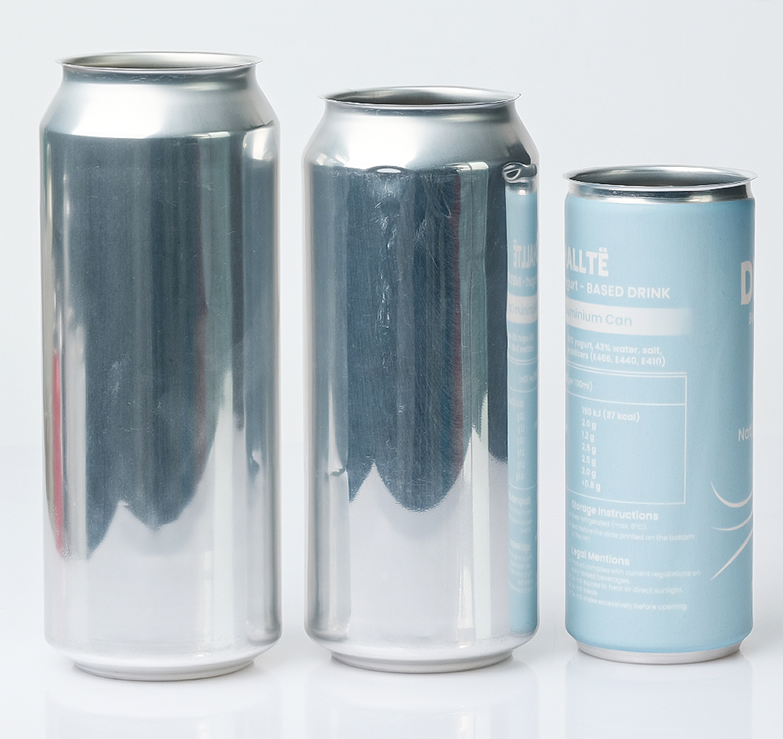
| Can Formats | Slim, Sleek, Standard | Target shelf profile and filling line mechanical geometry |
| Volumetric Capacities | 250 ml, 330 ml, 355 ml, 473 ml, 500 ml | Required net fill volume, headspace, and thermal expansion room |
| Can End Size | 202#, 206# (Lid Diameter) | End diameter compatibility with existing seamer chucks and rolls |
| Body Material | Food-Grade Aluminum Alloy | Alloy selection suited to beverage acidity and carbonation levels |
| Internal Coating | 100% BPA-Free Protective Lining | Batch COA and third-party lab test documentation (not verbal claims) |
| Lid / Opening Types | SOT (Stay-On Tab), EOE (Easy-Open End), Full-Open End | Opening style matched to target consumer usage occasion |
| Decoration Options | Natural Aluminum, White Base Coat, Full-Color Printing | Base coat selection, artwork registration, and color targets |
| Surface Finishes | UV Printing, Shrink Sleeve, Self-Adhesive Label; Glossy / Matte | Physical finish sample approval before starting mass printing |
| Quality Gate | Pre-Shipment Inspection with formal test report | Test parameters and AQL threshold agreed prior to production |
Food-Contact Compliance & Quality Assurance Protocols
Regulatory compliance is the constraint that disqualifies a supplier fastest. HK Rocsun backs every container run with rigorous documentation and multi-stage inline quality controls:
Behind the lab report sit six strict factory quality controls:
- Raw Material Coil Verification: Every incoming batch of primary aluminum coil is checked against its manufacturer Certificate of Analysis (COA) before stamping.
- Coating Adhesion & Thickness Checks: Cross-hatch adhesion and solvent-resistance testing verify the bond strength of the internal BPA-free lining.
- 100% Inline Pressure & Airtightness Testing: Every single unit passes automated inline pressure testing under seal-integrity control before packing.
- Cap Torque & Flange Control: Flange width, roll clearance, and top-end tolerances are continuously measured against seaming specifications.
- Print & Vision Inspection: Automated vision systems verify full-color graphics, logo placement, and print registration against approved pre-production proofs.
- Batch Sample Retention System: Physical samples from every production run are held in our management archive to ensure full batch traceability.
Commercial Boundaries, Capacities & Lead Times
To keep high-speed bottling facilities operating without inventory gaps, HK Rocsun operates under transparent commercial terms:
| Commercial Item | Standard Terms | Practical Implication for the Buyer |
|---|---|---|
| Minimum Order Quantity (MOQ) | 100,000 pcs | Standard mass-production pricing bracket for custom printing |
| Monthly Supply Capacity | 300,000,000 pcs / month | Volume ceilings do not constrain brand scaling |
| Lead Time (1 – 10,000 pcs) | 7 Days | Short-run validation and trial window |
| Lead Time (10,001 – 500,000 pcs) | 15 Days | Standard mid-volume production replenishment cycle |
| Lead Time (Above 500,000 pcs) | Negotiated Schedule | Dedicated production planning per project |
| Standard Incoterms | FOB, CIF, EXW | Cost and risk transfer points tailored to your freight forwarder |
| Payment Terms | 30% T/T deposit; 70% T/T against B/L copy | Cash-flow alignment with balance released upon shipping proof |
| Export Packaging | Heavy-duty export pallets & cartons | Stacked with protective interlayers and tight shrink wrapping |
A Six-Step Verification Sequence for Aluminum Can Buyers
This six-step workflow is designed for the evaluation stage. Each step generates a decision or document that the next step depends on, preventing common procurement mismatches:
1.Fix the Product & Line Interface:Match container geometry to your filler tooling。
Confirm can type (Standard, Sleek, Slim), capacity (250ml–500ml), and seamer end size (202# or 206#). Ensure equipment parameters match your filler and seamer.
2.Define Food-Contact Requirements & Evidence:Request third-party test reports and batch COAs。
Specify the internal lining as 100% BPA-free. Request supporting documentation: BPA Test Report ZTS25012103ERC, incoming coil COA verification, and retention sample protocols.
3.Select the End & Sealing System:Select opening style based on consumer occasion。
Choose between SOT, EOE, or Full-Open lids across Standard, Wide, High, or Special easy-open end variants. Verify integrated sealing gasket integrity.
4.Lock Decoration & Artwork Workflow:Digital proofing and 3D mockups before run setup。
Select decoration route (UV printing, shrink sleeve, self-adhesive label) and finish (matte, glossy, metallic). Approve digital proofs and 3D mockups prior to mass production.
5.Convert Specification into Commercial Terms:Align order size with factory volume tiers。
Confirm order volume clears the 100,000 pcs minimum for mass pricing. Fix Incoterms (FOB/CIF/EXW) and payment terms (30% T/T deposit, 70% T/T against B/L copy).
6.Set Pre-Shipment Inspection & Acceptance:Establish AQL limits prior to production run。
Define test parameters and Acceptance Quality Limits (AQL) in advance. HK Rocsun issues a formal Pre-Shipment Inspection Report before goods are loaded.
Category-Specific Application Analysis
The four constraints operate differently depending on the beverage category inside the container:
- Craft Beer Programs: Beer is highly pressure-sensitive. Solid base formation, top-end flange integrity, and airtightness are critical. Our BPA-free lining preserves delicate hop profiles and carbonation levels. (Example: A US craft brewery account runs at an annual contract value of USD 1.2 million with stable production compliance).
- Soda & Carbonated Soft Drinks (CSDs): Carbonated soft drinks combine high internal pressure with rapid line speeds. End diameter matching (202#/206#) and lid gasket integrity must be validated on your seamer prior to full volume scaling.
- Functional & Energy Drinks: Functional beverages place heavy emphasis on visual shelf differentiation and multi-SKU printing. Full-can UV printing and shrink sleeve options allow distinct graphics across a single body shape. (Examples: UAE beverage plant running USD 500,000/yr; Kazakhstan plant running USD 500,000/yr).
- RTD Coffee, Juices & Fruit Wines: Ready-to-drink coffee and fruit wines require high coating integrity and corrosion resistance due to acidity and extended contact times. (Examples: UK fruit winery account running USD 800,000/yr; Korea winery account running USD 400,000/yr).
FAQ
Are HK Rocsun aluminum cans certified for food-contact safety?
Yes. Internal linings are 100% BPA-free by specification, verified under Bisphenol A test report ZTS25012103ERC against EU regulations (EC) No 1935/2004, (EU) 2018/213, and (EU) 10/2011. Every batch is COA-verified, 100% pressure-tested inline, and manufactured under ISO 9001, FDA, and CE certified operations.
What can formats, capacities, and end sizes can be supplied?
We produce Slim, Sleek, and Standard can bodies in 250 ml, 330 ml, 355 ml, 473 ml, and 500 ml capacities, compatible with 202# and 206# can ends in SOT, EOE, or full-open styles. Custom colors, matte/glossy finishes, and full-can UV printing are fully supported.
What is the minimum order quantity (MOQ) and commercial structure?
Our standard MOQ for custom-printed mass production is 100,000 pcs. Incoterms include FOB, CIF, and EXW. Standard payment terms are 30% T/T deposit before production and 70% T/T against B/L copy.
Can a buyer validate line performance before placing a large volume order?
Yes. Orders in the 1–10,000 pcs tier carry a rapid 7-day lead time, serving as an operational validation window for testing line seaming, lid fit, and graphic print registration before scaling to mass runs.
Conclusion: Buy the Document, Not the Description
Successful aluminum can sourcing is decided by four verifiable constraints: a BPA-free lining backed by third-party test reports and batch COAs, body and end geometry matched to your seaming line (202#/206#), a transparent commercial envelope (100,000 pcs MOQ, 30/70 T/T terms), and lead times supported by a 300,000,000 pcs/month capacity.
HK Rocsun (Rocsun Eco) operates against this exact framework from our international business hub in Hong Kong, bringing technical accuracy, massive manufacturing scale, and professional export coordination to global beverage brands.
Next Step: Request a Technical Quotation & Spec Package
If you are evaluating aluminum cans for a craft beer, soda, energy drink, RTD coffee, or juice project, request a specification-matched quotation and complete compliance document package before committing to volume:
- Official Web: https://www.rocsuneco.com/
- Email: tom.ideabottle@gmail.com
- Direct Tel / WhatsApp: +86 185-5501-9935